The Stadium · Story
A shield for the nation: the story of Talanta's facade
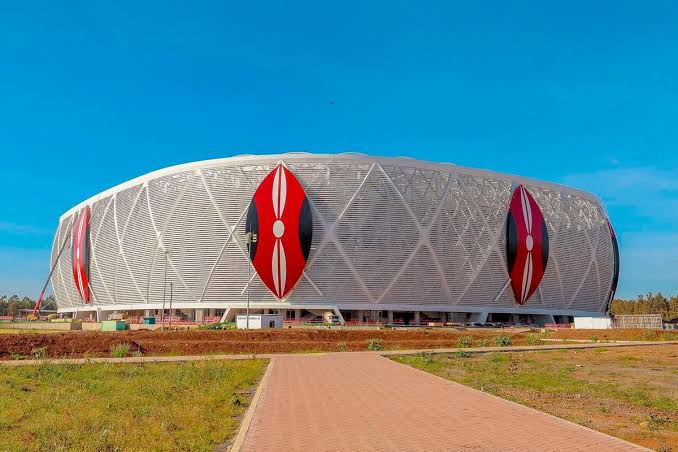
Kenya's new national stadium wears the national emblem on its skin: a white lattice ring carrying eight red-and-black shield-and-spear motifs taken from the flag.
A shield you can see from Ngong Road
Drive west along Ngong Road past Dagoretti Corner and the Raila Odinga International Stadium at Talanta Sports City rises out of the old Jamhuri grounds as a pale, woven drum. At intervals around its circumference, giant shields interrupt the weave: red, edged in black, split by a white spine and crossed by the spears of the Kenyan coat of arms.
From a distance you do not read a stadium first. You read a flag. That is the point of the facade, and it is the story of how a 60,000-seat bowl of concrete and steel was given a face that says Kenya before it says football.
The emblem it borrows
The shield at the centre of Kenya's flag is a modified Maasai shield with two crossed spears, adopted with the flag at independence on 12 December 1963. It stands for the defence of everything the flag's colours represent.
Those colours carry the story the stadium now wears:
| Element on the flag | What it stands for |
|---|---|
| Black | The people of Kenya and of Africa |
| Red | The blood shed in the struggle for independence |
| Green | The land and its natural wealth |
| White bands | Peace, honesty and unity |
| Shield and two spears | The defence of freedom and of those values |
The emblem has deep political roots. The Kenya African Union put a shield and weapons on its black-red-green flag in 1952. At independence, a committee set up by Jomo Kenyatta merged the rival KANU and KADU flags, added the white bands, and placed the shield and spears at the centre as a symbol every Kenyan could share.
From a shield-shaped stadium to a shield-faced one
The shield was always the idea; what changed was where it lived. The first rendering in September 2023 shaped the whole stadium like a Maasai shield. The building now on site is a conventional ellipse that wears the shield on its facade instead.
The concept design came from the University of Nairobi Enterprises and Services (UNES), with Professor Erastus Abonyo as lead consultant. Major Victor King'e of the Ministry of Defence is the project architect, the Kenya Defence Forces Engineering Department supervises, and China Road and Bridge Corporation builds.
| When | What changed |
|---|---|
| Aug–Sep 2025 | Press reports the switch: a "contemporary, fully covered arena" with large shield motifs on its skin |
| 1 Mar 2024 | Groundbreaking; capacity now 60,000 in an oval, three-tier bowl |
| Sep 2023 | First rendering: an asymmetric, shield-shaped stadium for about 50,000 |
The trade was practical. An ellipse is simpler to roof, cheaper to build and maintain, and gives every seat a clean line to the pitch. Moving the emblem from the plan to the facade kept the symbol and made it visible to everyone outside, not only to people looking down from the air.
The white lattice: the flag's peace band, wrapped around a bowl
The white skin is the flag's white fimbriation turned into architecture: the band of peace that separates black, red and green becomes the field that holds the shields.
Up close, the lattice is a web of crossing diagonals forming tall diamonds, with finer horizontal slats filling each one. It reads as woven rather than solid: a screen around the concrete bowl, not a wall. Published project documents so far do not name the cladding material.
The white does several jobs at once:
- Climate. Nairobi sits barely south of the equator. A pale, open skin reflects the high sun and lets air move through the concourses behind it.
- Contrast. Against white, the red shields carry from hundreds of metres away. A darker skin would swallow them.
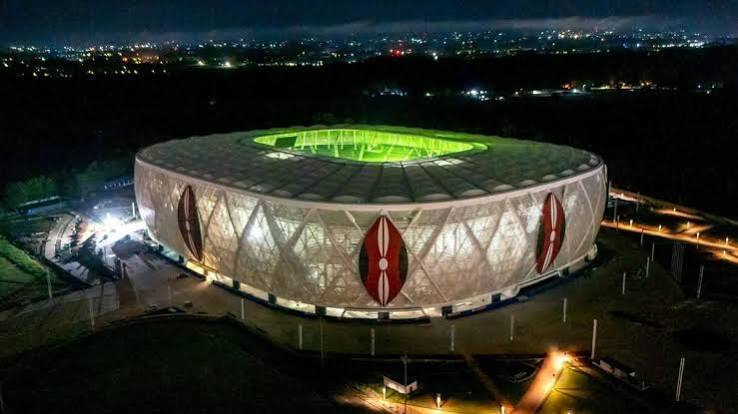
- Night. Lit from inside, the open weave glows. After dark the stadium becomes a lantern on the Ngong Road skyline, with the shields standing out as silhouettes.
- Meaning. In the flag, white stands for peace and unity. Here it is the largest surface on the building, holding every other symbol in place.
Eight red shields that are also eight front doors
The shields are not decoration hung on the skin. There are eight shield-and-spear elements around the facade, and each one lines up with a stadium entrance.
Project architect Major Victor King'e describes them as part of the crowd-management system. With 60,000 people arriving on match day, fans can steer by the nearest shield to find their gate. The emblem doubles as a landmark.
Each shield copies the flag's version faithfully: a tall red oval edged in black, split by a white central spine, with a spearhead at the top and a spear butt at the bottom. The shields rise through most of the facade's height, so each one reads clearly from the plaza, the approach roads and the air.
The facade is also built for light. It carries LED lighting and integrated digital advertising. By day the shields are bold red on white; at night the lattice glows and the shields stand out against it.
What the facade says
The facade makes the stadium a national monument first and a sports venue second. Inside, the seats continue the theme in the flag's black, red and green.
The timing adds to the meaning. President William Ruto announced the renaming to the Raila Odinga International Stadium on 12 December 2025, Jamhuri Day. That is the anniversary of the day in 1963 when the flag the facade quotes was first raised.
The building opens on 5 January 2027 with FC Bayern München against AFC Ajax. In June and July 2027 it is set to host the Africa Cup of Nations, which Kenya co-hosts with Uganda and Tanzania. For visiting teams, broadcasters and fans from across the continent, the first image of Nairobi many of them see will be a white drum carrying Kenya's shield: an emblem of defending what the nation values.
A flag you can walk into
Most stadiums fly the flag from a pole. This one is built so you walk in through it. The white lattice gives the flag's message of peace a physical form, and the red shields mark each way in, so every match starts by passing under the national emblem.